
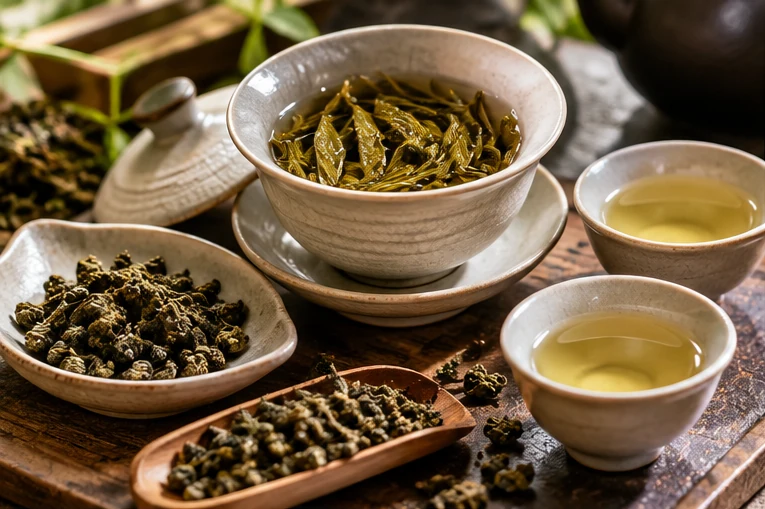
Tea names can feel endless, but the main processing families are a useful map. They all begin with the tea plant, Camellia sinensis; the differences come from the leaf, harvest, processing and storage rather than six unrelated plants.
Traditional practice and popular belief are reported as cultural context, not clinical proof. Studies of capsules, oils or concentrated extracts do not establish identical effects from a brewed drink. Sources below are available to check; this page has not undergone independent clinical peer review.
What counts as true tea?
Green, white, yellow, oolong, black and dark/post-fermented teas are processing categories of Camellia sinensis. Botanicals like rooibos, chamomile and mint are infusions, sometimes called tisanes. They are real drinks with their own traditions, but they are not the same plant.
A familiar mistake is assuming white tea always has the least caffeine or dark tea has none. Caffeine occurs naturally in the tea plant, and the concentration in a finished cup changes with leaf material, quantity, brew time and cup size. Colour alone does not give an accurate milligram figure.
Green, white and yellow
Green tea is heated early in processing to limit enzymatic oxidation. Japanese teas are often steamed; many Chinese styles are pan-fired. White tea is generally withered and dried with comparatively gentle handling, though individual makers use different techniques.
Yellow tea is a less common category whose processing includes a yellowing or resting step. Terms like “minimally processed” can obscure how much variation exists inside each family.
Oolong and black
Oolong covers a particularly broad range of controlled oxidation, shaping and roasting. Tieguanyin and Wuyi rock oolongs can taste strikingly different despite sharing a category. Black tea undergoes more extensive oxidation; Chinese descriptions often call this family red tea because of its liquor colour.
Avoid treating any of these processing styles as a medical formula. The sensory differences are clear; clinical claims must be assessed separately for the specific beverage and amount consumed.
Dark tea and pu-erh
Dark or post-fermented teas include families where microbial activity, ageing or particular storage practices matter. Sheng and shou pu-erh are distinct approaches, and storage condition affects quality. Fermentation does not remove all caffeine.
Tea labels may use geographic or protected names, and a regional name does not itself establish authenticity or quality. Learn the provenance of a tea rather than assuming the processing label tells the full story.
An easy tasting experiment
Start with an unsweetened small cup of two contrasting true teas, such as a fresh green and a gently roasted oolong. Note aroma, texture, bitterness and aftertaste. Brew at the temperature recommended by the tea maker, then adjust to your liking.
If you avoid caffeine, choose a verified caffeine-free botanical infusion instead. Decaffeinated tea generally has much less caffeine, but it is not necessarily zero.
The wellness perspective
Tea is an enjoyable source of fluids and plant compounds, but sweeping claims that a tea colour cures disease are not justified. The NIH National Center for Complementary and Integrative Health distinguishes tea as a beverage from concentrated green tea extracts, which have a different risk profile.
For everyday choices, drink what you enjoy, limit added sugar and consider caffeine sensitivity. The interesting world of tea is more than a list of supposed health benefits.
Questions readers ask
Does white tea have no caffeine?
No. White tea comes from the caffeine-containing tea plant, and exact levels vary.
Is pu-erh naturally decaffeinated?
No. Fermentation and ageing do not make it caffeine-free.
Is rooibos a seventh type of true tea?
No. Rooibos is an infusion from a different plant.
Sources and further reading
Public-health references supporting the major claims. OngTeh has paraphrased these sources and identified form/dose limitations.