
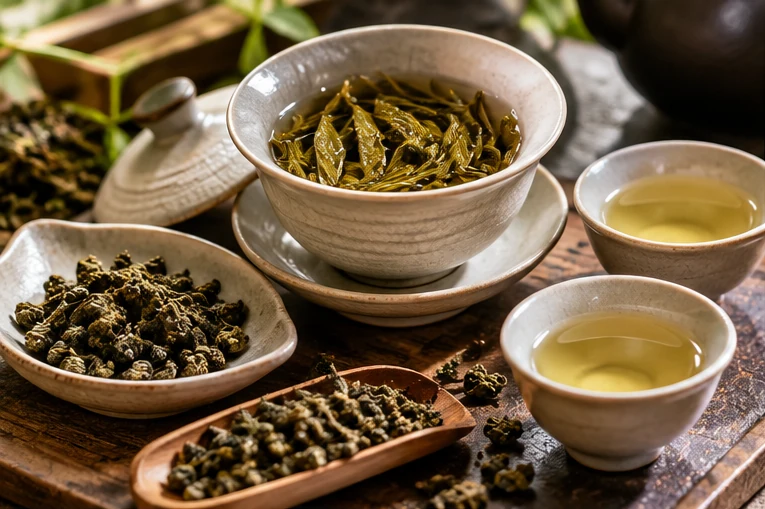
A headline about green tea can be referring to a brewed drink, a capsule containing concentrated extract, or a laboratory test. Those are not equivalent exposures.
Traditional practice and popular belief are reported as cultural context, not clinical proof. Studies of capsules, oils or concentrated extracts do not establish identical effects from a brewed drink. Sources below are available to check; this page has not undergone independent clinical peer review.
The beverage people know
Brewed green tea is made from Camellia sinensis leaves. It contains caffeine and several classes of plant compounds, including catechins. A cup can be a useful unsweetened drink in an ordinary eating pattern.
Strength depends on leaf quantity, water, brewing and serving. No standard cup is guaranteed to deliver the same catechin amount as a supplement in a clinical trial.
What human studies suggest
NCCIH summarises research indicating that green tea preparations may produce small changes in some cholesterol measures, but many studies tested extracts. Evidence for cancer prevention is inconsistent, and green tea cannot be presented as a cure or proven protection.
A statistically detectable effect in a trial is not the same thing as a clinically important change for everyone. Nutrition, lifestyle and medical treatment still matter much more than a single beverage choice.
How extracts differ
Some concentrated supplements deliver much larger amounts of catechins. NCCIH reports uncommon cases of liver injury, primarily associated with extracts rather than normal tea beverages. Supplements can also have medication interactions.
It would be misleading to show a photograph of a teacup next to an extract-based study and say that the benefits and risks are identical.
What about caffeine?
Both regular brewed green tea and many green tea extracts contain caffeine. Anyone who has palpitations, sleep disruption or particular medical considerations should account for all caffeine sources.
Do not infer that a short steep, low water temperature or white-looking tea leaves eliminate caffeine.
Medication and pregnancy considerations
NCCIH describes evidence that green tea can affect some medications, including nadolol, and warns that herb–drug interactions deserve individual attention. Pregnancy and breastfeeding call for tailored caffeine advice.
Medical or pregnancy questions should not be settled from a general wellness article.
A practical takeaway
If you enjoy green tea, have it as a beverage for its taste and place in a balanced routine. Be sceptical of fat-burning, cancer-cure and “liver detox” claims. Read research carefully to identify what was actually tested.
Questions readers ask
Does drinking green tea cure cancer?
No. Research does not establish that green tea prevents or cures cancer.
Are green tea capsules as safe as brewed tea?
No. Concentrated extract supplements have a different risk profile.
Can I drink green tea at night?
It contains caffeine. A naturally caffeine-free infusion may be a better choice for caffeine-sensitive readers.
Sources and further reading
Public-health references supporting the major claims. OngTeh has paraphrased these sources and identified form/dose limitations.